Friday, April 18, 2014

Dispatches from Urban Acrobatics Chicago Day 2: The Workshops


Yesterday we held back to back workshops at Alternatives, Inc. The first, a tagging workshop, was led by Werm. After a run to home depot with some of his family to pick up materials for the temporary wall for the show, which involved a discussion of what CAB stands for "Chrome and Black," among many other titles, and putting up a Werm on the already heavily tagged lockers in Alternatives, he wrote out an alphabet in his hand written style with upper-case and lower-case letters.

Wall-to-be. Photo credit: Caitlin Bruce
With waves of five to six youth arriving every twenty minutes, he broke down tagging into six steps. "First, you have to write your name in legible letters, spaced apart." He walked around checking on youth's work, helping them space and increase the size of their letters. 
Attentive students. Alternatives, Inc. Photo Credit: Caitlin Bruce
"Next, you need to put an outline around them." "Like bubble letters?" a student asked. "It can be." He wrote WERM on the whiteboard in black marker. Some of the students picked up the form easily, writing large proud letters on their sheets of paper. Others had to go through several versions, first finding that when the letters are too small, they crowd together and an outline is not possible. After the outline stage Werm signaled the next step. "Now we make a three-d. You have to have short lines extend from the edges of the letters all in the same direction." 

Werm demonstrating making three dimensional letters. Alternatives, Inc. Photo Credit: Caitlin Bruce
This step was harder to follow, some students with colliding lines creating multiple planes of movement. He walked around explaining how the shadow must fall, and pointing to the board. The final step was to connect the edges of the three-d shadow. Finally, students were directed to choose a lighter color for the inside, and a darker outline for the outside. 
A tagged by one of the more advanced students. Alternatives, Inc. Photo Credit: Caitlin Bruce
Wrapping up, Werm demonstrated how one could draw an aura around the letter in the form of a cloud, shapes, shine, and so on. We concluded by describing the project to the students, and suggesting that in the circus exercises they should think about how they could integrate graffiti styles, or even the practice of painting. One of the more eager Circus students tried juggling paint cans, an object he had not juggled before.

Juggling paint cans. Photo credit: Caitlin Bruce
The tagging workshop was followed by some circus exercises, led by Polly. The first was a movement exercise where students were put in a circle and each had to imagine a movement that either positioned the body up in the air, a standing level, or low down. A movement level could not be repeated twice, so, for instance, if someone did a pose on the ground, the next pose had to be standing or up high. With eleven participants, the movements were repeated over and over to make, what one student described as a "weird dance," but a dance that was collectively written by the participants. Following the dance, the smaller group began working on making pyramids, and team-work exercise that requires clear communication and collective effort. "You can't just climb up on someone," Polly cautioned one of the smaller students who would be on the top of the pyramid, "You have to tell them, and make sure it's ok." 
Human Pyramid. Alternatives, Inc. Photo Credit: Caitlin Bruce
After directing the students into making a vase-like shape with one level of the human statue facing in one direction, and upper level facing the opposite way, Polly suggested that the students find their own shape that includes every participant. What resulted was an elevated bridge-like structure that visually mimicked the shape of Chicago's bridges and overpasses connecting both sides of the river, surfaces that are important targets for tagging.
Teamwork, to make two bridges. Alternatives, Inc. Photo credit: Caitlin Bruce

Today will begin the planning for Saturday's performance. We hope to see you soon!
Werm making his presence known at Alternatives. Photo credit: Caitlin Bruce

Wednesday, April 16, 2014

Dispatches from Urban Acrobatics Chicago: Day One, Panel Discussion

Our panel discussion session took place at the Evanston Art Center, and was chaired by the EAC Director of Education W. Keith Brown. Keith opened the session by discussing the a hip hop and street art as pedagogy series of programming that he developed in the spring of 2013, which investigated how subcultural practices like breaking, dj-ing, rapping, and graffiti, the four elements of hip hop, are subcultural practices that also deserve to be recognized as legitimate art forms. Crucially, the weekend explored what it was for a subcultural form to move from margin to center. The weekend was also part of a broader desire on the part of the Evanston Art Center to make it a space for a range of art forms that are accessible to a broad public, not just more traditional art forms. The Urban Acrobatics panel, then, functioned as a bridge to continue the conversation about art forms that may occupy marginal positions even though their effects are intensely public: circus and graffiti.
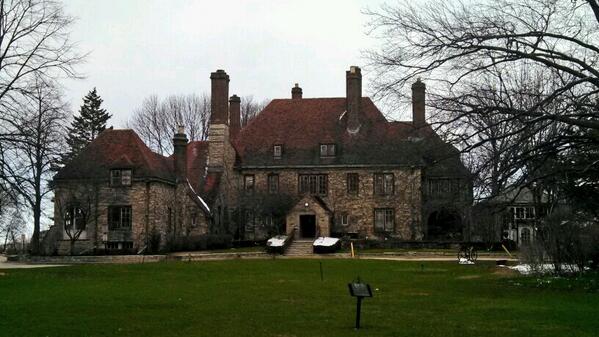
Evanston Art Center. Photo Credit: Polly Solomon
I opened by summarizing some of the inspirations and premises for the project: struck by reading about Twyla Tharpe's "Deuce Coup" performance in 1983 where young writers painted a rolling canvas behind the Joffrey Ballet, I had contacted my long-time friend, Polly, about staging encounters between circus and graffiti artists around three elements that I saw in common aesthetically and politically: publicity, spectacle, and movement. Graffiti, I elaborated, is an aesthetic based on movement, being both the "visual equivalent of the freeze," (an insight from Flash), and letters that possess a dynamism, linked to a history of trains and travel from post-WWI rail inscriptions to the 1970s New York City Subway graffiti movement. In New York we began to explore these themes, particularly in staging the circus artist as an urban acrobat that can perform graffiti from daring angles: upside down on silks, perched upon Lyra, or juggling while sporting painted attire. Polly led stop-motion drawing exercises to impact images with movement and then attempted to repeat the exercise from the air.

Gabriel FLASH Carrasquillo, who is an engineer, artist, photographer, and educator, shared some of his vast archives of Chicago-based graffiti and street art that go back to the 1970s. He is in the process of collaborating on a book that chronicles the history of Chicago graffiti from the 1970s to 2003 (when the first Chicago Meeting of Styles) took place. It was a treat to see early throw ups on the Red Line Chicago stop; Logan Square and Wicker Park before gentrification; and the evolution of Chicago style. Flash noted that "sprinkles of color and fades..dustings of pinks and blues" versus the screaming reds and oranges of early New York subway pieces distinguished Chicago early on. Flash started writing in 1983, after the moving "Style Wars" came out, and was influenced by Chicago youth who had returned from New York after picking up graffiti styles. He received the name "Flash," because he was known for carrying around a 35 millimeter camera. He was part of ABC (Artistic Bombing Crew), who were among the first Chicago-based crews, and painted all over the city. After retiring in 1987 he returned to the scene in 2003. Flash's retirement coincided with the disappearance of a "whole generation of writers." Although when graffiti started in Chicago it was met with confusion or indifference, "CTA workers would say 'Good night writers,'" Flash had joked, by the 1990s it was an all out graffiti war.
Flash autographing our poster. Evanston, IL. Photo Credit: Caitlin Bruce
Even today such disproportionate treatment in response to graffiti continues. Flash explained that different city departments: CTA, Streets and Sanitation, and the Parks Department, have their own graffiti buffing budget. What if such funds were turned towards finding legal venues for youth?
This is Flash's mission, creating space for the old school and the new school, which will also educate a broader public about graffiti's artistic potential. Flash curates a set of walls in Logan Square, the neighborhood where he "did his damage" in the 1980s as a way to give back.

"Project Logan," includes a large wall with 174 sections, a slightly smaller crew wall, and a yet slightly smaller dedication wall, on which works stay up for a long period of time. Finally, there is a little "two spot" section which is exactly that: two spots, for two people, which stays up for two weeks at a time. Yet, even during the seemingly short period of two weeks the wall, which is viewable from the blue line, will be seen by over two million people. Project Logan is a visual extension to Flash's book project, where he displays work from artists who were pioneers but part of that "lost generation."KLTA was one of the first artists who were displayed on the wall, a street artist who,  between 1983 and 1987 had works on over seventy rooftops throughout Chicago.

Creating legal venues like that of Project Logan is crucial to giving youth an outlet. Flash explained: "They will always have the paint, and if they don't have a legal spot...they will paint somewhere else." Flash's work at Project Logan exhibits a relationship of stewardship between the old school and the new school: older generations of graffiti artists, and younger. Such a relationship involves imparting "a culture and a code." In cities like Chicago, Flash argued, many non initiates are blinded by a culture that is imparted by strict anti graffiti laws, preventing artists (and art lovers) from benefiting from a market that is vibrant across many cities outside Chicago. The past mayoral administration(s) continued this culture of demonization, even buffing permission walls, or "blowing up paint cans," a "no write" policy that fomented an antagonistic relationship between city officials and writers that is captured in the film "I Write on Stuff." Flash contrasted Chicago's anti graffiti culture with that of Paris, where, he suggested "permission pieces stay up for a hundred years."Such a climate is changing, Flash added, hopefully, with the new mayoral administration.

Roy Gomez-Cruz artfully discussed some of the spatial and social dynamics of learning about circus art in Chicago, performance scenes that are inflected by changing industrial landscapes, and bodies that engage, resist, and transform prevailing gender binaries. However, learning how to do circus acts involves putting the body on display in ways that are uncomfortable, involve judgment, and "risk and failure." The idea of learning a public art genre that requires the practitioner to confront ongoing possibilities of failure and risk resonates with Flash's formulation of the risks of writing, in terms of the ephemerality of the work, social judgement (and misjudgement), and the risk of it being denigrated. "Circus training lets the body become spectacular," Roy opened, "through body to body encounters...[that] puts bodies at risk" in ways that are physical and also social. Focussing on Aloft Loft, Roy analyzed his experience as a newcomer and a male in a largely female aerial acrobatics community as an encounter with discomfort, uncertainty, and feeling not at home. However, such feelings of being out of place are not necessarily bad, they provided, in his account "opportunities to exercise self reflexivity." The circus world(s) Roy engages largely engage in an avant-garde form of circus, and he has been attending shows regularly since 2011. In one such show, Roy observed Aloft Loft founder Shayna Swanson manipulating a German wheel in a masterful performance of strength, endurance, and industrial materials, "dominating gracefully the circus apparatus [in] a performance [that] is an extension of the landscape outside." As a new practitioner, Roy notes that the "body is mute as a new practitioner." This idea of being ineloquent in a new aesthetic form carries across genres-- in graffiti new writers must practice the tag over and over to get it down to a deft art. Although circus training involves risk and vulnerability, Roy concluded, perhaps such training may "allow us to meet others."
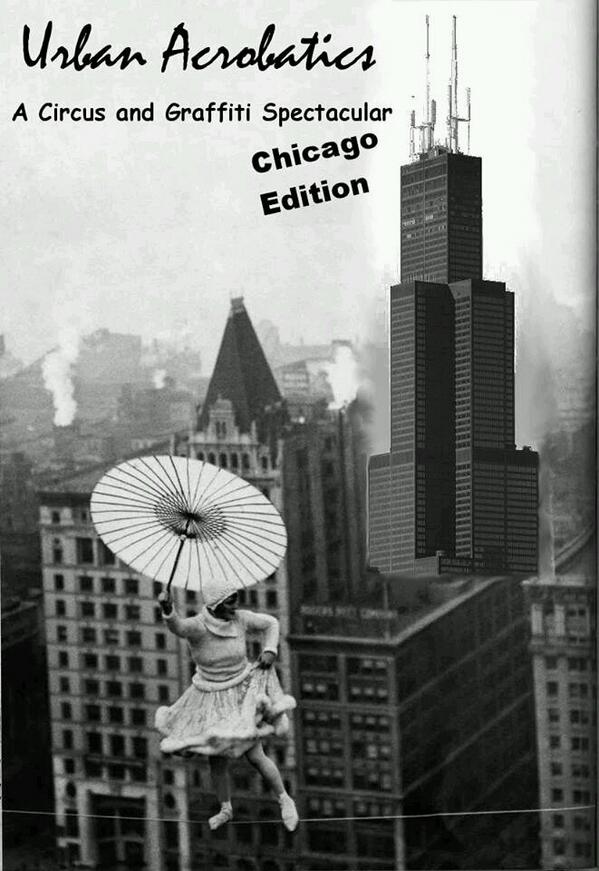
Image compilation by Polly Solomon
Flash's discussion of Chicago graffiti, which is met by the general public by a mix of misunderstanding, intrigue, interest, and fear, mirrors some of the misperceptions surrounding the circus scene. Contextualizing the Circus Now movement, Polly Solomon explained that in the U.S. federal arts funding agencies, including the NEH specifically ban circus projects from consideration under the rubric that they are "not art." This designation of "not art," is one familiar to graffiti writers. Moreover, Polly marked that graffiti and circus share elements of danger. Illegal writing has dual elements of risk or danger: the risk of getting caught, and penalized, but also the risks attendant in illegal underground practice of tripping or falling from great heights. Acrobats and writers perform feats of daring that defy the imagination.

In both genres practitioners use movement in the creation of their art (swinging from trapeze, dance, acrobatics for circus, bent knees whole arm movements and sometimes climbing out of the way places for graffiti) but also in the circulation of their own bodies. Referencing our conversation with Melon the other day, Polly remarked that in doing graffiti some writers are so close to the micro details of their work that when they step back they are amazed about what has been created. In a similar sense for circus performers it is difficult to see the visual picture one is painting while doing an act. Notably, the train figures as an important trope in graffiti and circus lore. Additionally, Polly noted that in both graffiti and circus culture there is an intense reliance on one's crew or troupe or team. Such reliance comes out of necessity, one needs a spotter, or a lookout, or a partner for a complex pose or act, but also for a sense of community and identity. In many communities of practice the practitioners have a sort of volitional family.


Polly defined circus as: "a release from everyday mundane into extraordinary for audience for feats not achievable for everyday person such that it takes audience out of their world, [feeling] different than [just] walking down the street." She concluded by emphasizing that creativity is about inspiration, which is quite literally taking breath. "One of the ways that we can inspire [lies] in how we treat the next generation coming up, and teach them and let them teach us." This generational obligation, or ethic of care, resonated with Flash's "Project Logan" walls, as well as the potential Roy sees in circus enabling practitioners to teach and learn body-to-body encounters that may be generous and transformative. In Chicago, a city of industrial blocks, sharp class and racial division and inequalities, and sprawling neighborhoods, both circus and graffiti practice offers ways of being in common that rest on respect, risk, vulnerability, and inspiration that may shape more equitable, and more oxygenated urban spaces.


Monday, April 14, 2014

Urban Acrobatics Chicago: What Does Inter-Genre Collaboration Look Like?

What connects circus and graffiti, and how, aesthetically, can they be put into communication? This is a question that we will attempt to broach through discussion tomorrow, but today two of our performers, Melon James and Polly Solomon, began to imagine what it may look like through performance and shared movement.

Meeting with Melon, Polly first tried to describe what painting opportunities aerial acrobatics would allow, primarily by describing the relationship between her moving body and the fabric that sustains her in the air, lifts her up, and allows her to do fifteen to twenty foot drops. 

Urban Acrobatics NYC. September, 2013. Photo Credit: Sarah Alcantara.

What became increasingly clear is that in doing an aerial routine, it is not just about bodily poses, but the dance between texture and the body, a play with positioning, extension, gravity, and folds. "I move into different poses, and can sometimes hang out, for a slow count of ten or more," Polly explained, "and will drape the fabric so that it unfolds vertically or horizontally." Melon responded, "I am thinking about what I could paint in ten seconds...its like a game, because the fabric will shrink down, so [the question is] what can be painted?" What can be painted in ten seconds on a moving canvas that will have visual impact even as it is contorted, reversed, and turned upside down? A tag can be written in ten to twenty seconds, but can the tag retain its impact when spatially manipulated?

For the performance on Saturday, little is pre-written. All that exists are the constraints of space, and the opportunities afforded by materials and surfaces. There will be a drop cloth, a cellophane wall, the silk, and wooden panels. The challenge is to introduce moving bodies among and within those materials that can make the scene dance.
A work by Melon, in progress. Chicago, IL. Photo Credit: Caitlin Bruce
We mused about music, the soundtrack for the performance. For our New York show Polly mixed soundbytes from interviews I had conducted and selections from the panel discussion along with music, including a song about Chicago graffiti by writer and rapper Demon/Dmnology, but a different kind of soundtrack came to light: that of the paint cans themselves.

Lavie Raven taught a spraypaint workshop last year at the Evanston Art Center where he emphasized that to do graffiti one must develop an intimate relationship with the can and consider the energy and sound of the can as an extension of one's own breath. If the can breathes cleanly, lines will be clean as well. When watching live painting, then, it is as important to pay attention and listen the persistent hiss of aerosol paint and its steady, practiced rhythms, as it is to watch the unfolding of confident lines, pure colors, and deft fades.

Melon calls this "graffiti yoga." He explained: "I call it graffiti yoga, because, for me, since I'm not very tall, to get a line from here [gestures to floor to left] to here [gestures to upper wall to right], I have to really stretch to get a clear, straight line."Such practice is intimately related to animating the letters, keeping one's knees soft, shoulder contracted, and arm straight, which requires, even in the drawing stages, breaking free from the limits of the page. "Do you know Cove? He...influenced me...and told me, 'Don't limit yourself...you have to get off the sheet [of paper]." In such a sense, doing graffiti involves visible traces but also physical movements that are only visible in the dynamism of resulting lines. I mentioned how Ruben Aguirre, Like, mentioned at the same panel discussion in Evanston in 2013 that doing graffiti offered him a deep sense of quiet, and was an almost meditative practice. Melon mused that in his work he too falls into a meditative trance, one time falling so deep that he simply did not hear ten minutes of conversation. "The idea of breath...this is related to creativity as a process," Polly responded. "To inspire, that is drawn from the fact that the word inspire means [etymologically] inhalation, taking in breath. When you inspire them you become part of them, transforming them."
A work by Melon, in progress. Chicago, IL. Photo Credit: Caitlin Bruce

Inspire, exhale, and stay tuned for more updates tomorrow.

You can follow us on twitter @UrbanAcrobats and on instagram at urban_acrobats.
A tired but inspired Polly. Chicago, IL. Photo Credit: Caitlin Bruce


Sunday, April 13, 2014

Gearing up for Tuesday's Discussion: Shared Histories

The panel on Tuesday at the Evanston Art Center will serve as a way to open up discussion and jumpstart creative imagination about how circus and graffiti can communicate and collaborate.

Some questions that we will be working on:

* How does movement figure in the production and circulation of circus and graffiti art?

* Who is the public, or the spectators, that both genres are addressed to?

* What role do circus artists and graffiti artists play in public discourses in Chicago? Marginal actors? Heroes or heroines? Villians?

* How do graffiti and circus artists create, maintain, and develop space in Chicago, and how does the changing conditions of these spaces (economically, materially, socially) impact the performance of art?

* How, why, and for whom does circus and graffiti elicit wonder?

* How are both genres treated by art funders?


Check out the program below! Join us Tuesday, April 15th, at the Evanston Art Center at 6:30 for a panel presentation and discussion, followed by a reception.


Thursday, April 10, 2014

Urban Acrobatics Chicago Preparation: Visit to Alternatives and Paint Shopping with Werm

Yesterday I got to visit Alternatives, Inc. to meet the director, the wonderful Carmen Curet, and talk logistics with her and resident artists Andy Bellomo. Alternatives provides after school programming for youth, boasting classes in dance, circus, DJ-ing, computer technology, painting, and more. Walking around the site I got to see classrooms, kids working at computers, youth rolling around on unicycles, and an array of beautiful masks for their upcoming annual fundraiser. The front of the building, as well as walls in the hallways are covered with colorful mosaics.

Exterior of Alternatives, Inc. Chicago, IL. Photo Credit: Caitlin Bruce

Urban Acrobatics will be hosted by Alternatives, Inc. on Thursday, Friday, and Saturday, so come and check it out!

Today I went to Modest Skate Shop in Oak Park with Werm to select paint for the performance. Along the way we got to discuss his history as a graffiti writer, recent musical projects, and future goals.
Werm picking out colors for the Urban Acrobatics performance on Saturday, April 19th. Photo Credit: Caitlin Bruce

Werm started painting when he was 12, and in 1994 was able to join CAB crew, of which he is now the leader. He makes a living off of his art, doing signs, airbrushing, and murals. You can see his work all over the city, most recently at a wall that features a "He Man" action hero theme. His pieces often feature a worm character, curving in on the outsides to create a larger "w" shape. He is also a prolific rapper, best known for his songs "Paint Away the Pain" and "Wrong Side of the Tracks."

"Paint Away the Pain" is a remix of Mobb Deep's song, "Drink the Pain Away," and gestures to the cathartic release that writers can get from painting, a kind of artistic means of working through everyday problems. "Wrong Side of the Tracks" is an homage to the Artifacts, who, according to Werm, were the first rap group to feature live painting in their music video for their version of the song, "Wrong Side of the Tracks." His songs, like his artistic work, is fresh, powerful, and honest. One of Werm's goals is to paint in every major city in the world. To that end, he will be painting at the Houston Meeting of Styles in addition to the Chicago Meeting of Styles.

Anyone interested in learning the basics of tagging should check out his workshop, which will be on Thursday April 17th at Alternatives, Inc. from 5:00 to 6:45pm. You can check out his bio and soundcloud page on the April 8th post.
Colors for the Urban Acrobatics performance. Photo Credit: Caitlin Bruce

Until tomorrow!


Tuesday, April 8, 2014

Urban Acrobatics Chicago Edition: Schedule


We are thrilled to share our schedule for the upcoming week of Urban Acrobatics festivities based in Chicago.


As always, all events are free and open to the public.

Tuesday April 15:
Our first event will be a panel discussion on the history of circus and graffiti in Chicago. Our panelists are Polly Solomon, Gabriel FLASH Carrasquillo, Roy Gomez Cruz, and Caitlin Bruce. The panel begins at 6:30pm and will run to 8:00pm with a reception afterwards. We are grateful for the Evanston Art Center providing space for this event.

Thursday April 17:
From 5:00 pm to 9:00pm we will be hosting back to back tagging and circus workshops, led by Werm Oner and Polly Solomon. We will provide markers, paper, and space to draw and tumble in. This event is being held at Alternatives, Inc.

Friday April 18th:
From 5:00 to 9:00 pm our artists will brainstorm and prepare for Saturday's performance, which will offer a fusion of graffiti and circus styles. Our performers will include Polly Solomon, Werm Oner, Natalie Zombie, and Melon James, among others. This will take place at Alternatives, Inc.


Saturday April 19th:
From 4:00 to 6:00pm we will present the result of our week of discussion and collaboration in the form of a performance, a Spectacular. This will take place at Alernatives, Inc.

Some background on participants:

Polly Solomon:


Polly Solomon has been working in theater for fourteen years in NYC's biggest venues and throughout the NY tri-state area. While pursuing her degree Polly started training as an aerial acrobat and incorporating circus into dance and theater pieces. She performs and teaches circus in school, after-school, camp, studio, and theatrical and circus productions settings. Polly has directed several shows for the American Youth Circus Organization, most recently at the 2014 Chicago Contemporary Circus Festival this January.

Biography: I grew up in all the slums of chitown. Grew up in a bad environment. We were always broke and moving from house to house. Grew up in all the slums of the south side of Chicago. I always heard "NO" when asking for toys as a kid ,so at a young age started stealing.I found if i wanted something I had to take it. By the age of 12, i started doing graffiti. Cab 312 TFO was the best crew out (and still is). I wanted to be down for years, and finally in 1994 my dream came true. Ever since then I've taken all-city several times,an counting.....Graffiti took me all over the city , and made me feel a part of something bigger though my past was rough I wouldn't change a thing about it. It made me the man I am today. Its not where you been that matters, it's where your going that counts. I have three wonderful lil girls who are my heart. They love me unconditionally an MAKE ME BETTER. They're the reason I hustle hard an don't settle for less,an strive for more. My next goal is to go on a world wide tour and paint every city I go to. Music and art are my passion, also my way of expression and my therapy. I use music to say whats on my mind and get it out. Graffiti is like an adrenaline rush, it makes me feel alive and lets the world know I'm here too, but at the end of the day my ultimate goal is to make a better life for my kids and give them the life I never had. I thank God for life and all the opportunities he gives. To all my fans I love you and appreciate you all, for all the love and support. peace WERM ONE
Epresskit for Your Artistic Name Here
epresskitz.com

Melon James:


Melon has been writing graffiti since the early 1990’s specifically in Chicago for the Renegades (RGS crew). Later he joined the military and like himself “graffiti will travel”. His pieces not only have cluttered the slums of Chicago but also Hawaii. Melon has never feared the use of color and it can be seen in all of his work as he fearlessly uses color. Melon’s achievements do not only include permission wall pieces. This guy also wrecked shop on street level. Known as one of the top most skilled in Chicago and Hawaii because of his notorious hand skills and elaborate graffiti pieces, this guy can go toe to toe with the best. His bombing style was as fearless as his color usage.
Melon is a Chicago icon and will continue to be so long as Chicago is on the map. He has not only helped to push the art form in Chicago, but he is also renowned respected and up in Hawaii to. So keep on getting up because every production he does is eye candy. Follow him at: https://melonjams.squarespace.com.


Gabriel FLASH Carrasquillo:


Flash is an artist, an educator, and a graffiti historian. Growing up in Logan Square, he and his friends began writing after "Style Wars" came out in 1983. After a brief retirement from graffiti, Flash returned in 2003 and since then has been writing, teaching, and helping to get legal spaces for writers. He has given presentations at SILO Art Space, has exhibited at the 2013 Paint, Sticker, Paste show at the Chicago Cultural Center, as well as at Zhou B. Studios, among many other shows.

Roy Gomez-Cruz:


Roy is a PhD student at Northwestern University in the Department of Performance Studies.
His research engages contemporary circus as a multidimensional performance space where varied forms of circus tradition and popular culture are being reinterpreted for global audience’s consumption; the politics of labor practices in the itinerant circus; and aesthetic in circus and the connotations of transgression, grotesquery and bestiality historically associated with traditional circuses.

Caitlin Frances Bruce:


Caitlin is a PhD in Communication Studies, and is part of the Rhetoric and Public Culture Program at Northwestern University. Her research explores public art, urban space, and critical theory. She has worked with graffiti artists and muralists since 2010 in Chicago; New York; Mexico City; Ciudad Neza; León Guanajuato; and Paris, conducting interviews and writing about shows. She has published in Invisible Culture, Advances in the History of Rhetoric, Inopinatum, Sixty Inches From Center, Art Threat, Art Nerd, and on her blog Kinesthetic Urban Rhetoric.

Natalie Zombie: 

Natalie is Chicago based artist who does multimedia work as well as face painting (largely in monster/zombie genres). You can see some of her most recent work at Silo Art Space's Spring Fever show.

Tuesday, December 3, 2013

Clowns and Nationalism

As we get nearer to the second installation of Urban Acrobatics in Chicago, here is a podcast from a couple of professors that investigates the history of clowning and its relationship to nation, empire, and (to some degree) gender. Hear more at: http://www.professorfootnote.com/episode-one-clowning-around/